Medical Innovation
How Non-Invasive Ultrasound Technology Offers New Hope for Women with Fibroids
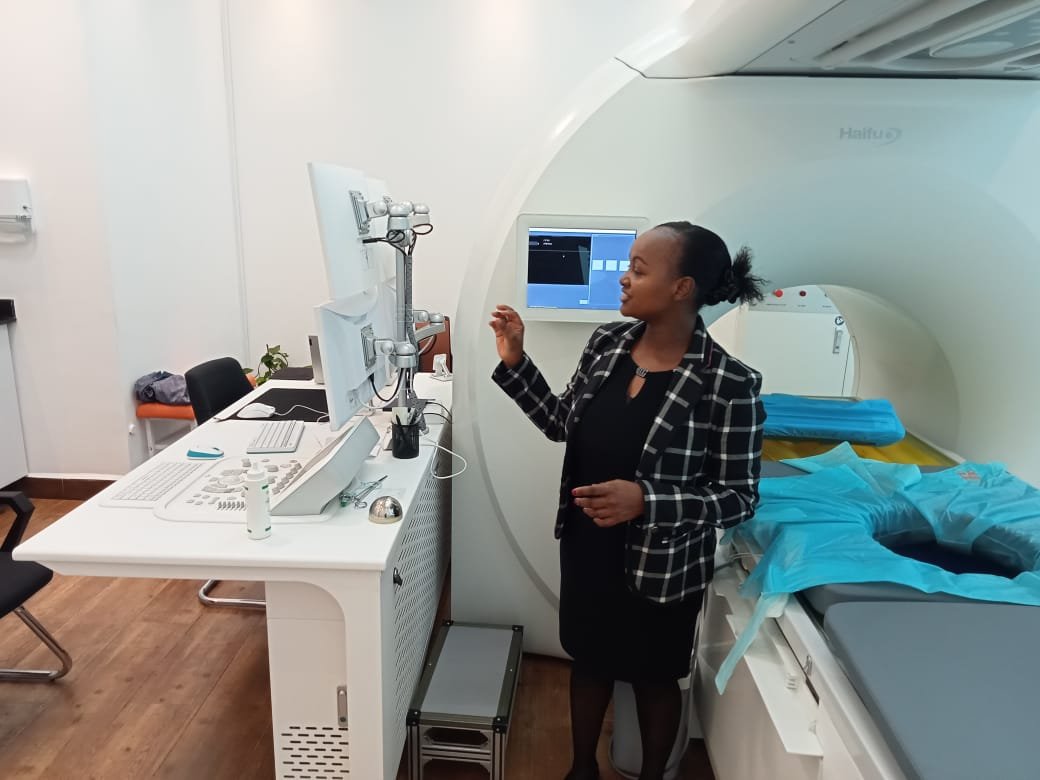
A revolutionary shift in the medical treatment of fibroids is gaining momentum with the increasing adoption of High-Intensity Focused Ultrasound (HIFU) ablation, a groundbreaking non-invasive technology now being used to treat uterine fibroids in Kenya. This innovative approach employs precisely directed ultrasound waves, presenting a compelling alternative to traditional surgical procedures. By offering the potential to treat fibroids without incisions, HIFU promises reduced recovery time and fewer surgical complications for patients.
At the core of this advancement lies the fundamental principle of ultrasound: sound waves operating at frequencies beyond human hearing, exceeding 20,000 Hertz. HIFU technology focuses these high-frequency sound waves onto a specific target within the body, creating a concentrated energy beam. This focused ultrasound allows clinicians to target and treat diseased tissue, specifically fibroids, with remarkable accuracy.
The process of HIFU ablation can be likened to focusing the sun’s rays through a magnifying glass. Just as the lens concentrates solar energy at a single point to generate intense heat, HIFU technology focuses ultrasound waves to create a thermal lesion within a fibroid. This localised heat, reaching temperatures of 65–100°C or higher, induces irreversible coagulative necrosis and effectively destroys fibroid cells. Crucially, this process is designed to avoid damage to surrounding healthy tissues, a principle known as conformal ablation.
The HIFU System developed by Chongqing Haifu Medical Technology Co., Ltd., which delivered its first treatment in 1997, is at the forefront of this technology. The system includes models such as the JC, JC200 and JC300, representing years of dedicated research and development. Each model is tailored to specific clinical applications to support optimal treatment outcomes for a diverse range of patients.
The clinical applications of the HIFU System extend to the non-surgical treatment of uterine fibroids and adenomyosis, conditions that can be debilitating for women. The system offers an alternative to hysterectomy, the surgical removal of the uterus, or myomectomy, the surgical removal of fibroids.
The global adoption of the HIFU System highlights its efficacy and safety. Clinicians in 33 countries and regions worldwide—including the United Kingdom, Germany, Egypt, Argentina, Singapore, Korea, Japan, South Africa and Nigeria—have embraced the technology. International recognition of HIFU’s benefits is growing, with medical institutions such as John Radcliffe Hospital in Oxford, UK, pioneering its use from 2002. In Spain, health officials have advocated for broader adoption in treating uterine fibroids and adenomyosis. The system is also widely used in South Korea, with regulatory approvals for several indications.
More than 318,572 patients had been treated with the HIFU ablation system as of December 2024. This extensive body of clinical experience, together with studies published in peer-reviewed journals, provides evidence supporting HIFU’s safety and efficacy in treating fibroids.
Clinical studies have demonstrated that HIFU ablation can achieve outcomes comparable to traditional surgical procedures for fibroids, with the added advantages of fewer complications, shorter hospital stays and lower overall medical costs. The non-invasive nature of the procedure—without incisions, punctures or bleeding—can translate to reduced pain and faster recovery times for patients.
HIFU ablation can also eliminate the need for general or spinal anaesthesia in the treatment of benign fibroids. Treatment planning considers the size, shape and location of each fibroid while aiming to preserve healthy organs and minimise collateral damage. In many cases, one treatment session is sufficient; the procedure may also be repeated if clinically necessary. Real-time ultrasound imaging supports precision throughout treatment.
As adoption expands, the HIFU System is distinguished by its high energy output and its ability to achieve substantial fibroid ablation in one session for suitable patients. This efficiency can support better patient outcomes and reduce the overall treatment burden.
The reported overall effectiveness of HIFU ablation for fibroids exceeds 95 per cent. Where treatment outcomes are less than optimal, clinicians can consider alternative strategies, including repeat HIFU following an individual assessment.
Ultrasound imaging can show immediate changes after the procedure, including loss of blood supply to the treated fibroid tissue. Fibroid shrinkage is gradual and commonly occurs over one to six months. While new or recurrent fibroids elsewhere are possible, repeat HIFU may offer an additional treatment option. Cost varies according to several factors, but can be lower than minimally invasive surgery because of shorter hospital stays, faster recovery, the absence of scars and bleeding, reduced injury to neighbouring tissues and the potential to preserve fertility.
Our first client shares her experience at Nairobi HIFU Centre
L.O., a patient in Nairobi recovering from fibroids, shared her positive experience with HIFU treatment at HIFU Medical Services Nairobi. She had experienced excessive bleeding and abdominal bloating for approximately seven years before undergoing the HIFU procedure on February 18.
“I feel okay because the procedure went very well and was seamless, and I’ve had an easy recovery period. I had a bit of abdominal discomfort and fatigue, which resolved within the first and second week after my procedure.”
She reported feeling much better, with reduced abdominal bloating and increased energy levels. “My back pain is less and I feel like I am on the right track,” she added. She encouraged other patients experiencing similar symptoms to consider the potential benefits of the non-invasive procedure.
“My hospital stay was brief. I was here in the morning and left by the evening, so it was very convenient and painless for me.”
A new option for women with fibroids and adenomyosis
Dr Kireki Omanwa, President of the Kenya Obstetrical and Gynaecological Society (KOGS), highlighted HIFU as a novel, non-invasive method for treating fibroids. He emphasised that fibroids and adenomyosis affect a significant number of women, particularly during their reproductive years, and that HIFU Medical Services Nairobi houses one of only a few such machines in Africa.
“We have one machine in Nairobi, one in Egypt, two in Nigeria, one in Tanzania and one in South Africa, making a total of six machines in the whole of Africa.”
Dr Omanwa explained that more than 3,000 cases had been treated in Africa and pointed to the prevalence of fibroids among women of African origin during their reproductive years.
“The traditional way to treat fibroids is by surgery—open or laparoscopic. This entails taking patients to theatre, where we make an incision to reach and remove the fibroids, but the HIFU method is non-invasive.”
“Women do not go to theatre, so they do not need anaesthesia or recovery time in the ward. This has a huge advantage for patients, both physically and psychologically.”
“Adenomyosis can cause very painful periods because tissue similar to the lining of the uterus is embedded in the uterine muscle. HIFU is an option for women who do not want surgery and want to continue having children.”
He advised women experiencing problems with fibroids to ask their gynaecologists about HIFU. “As the Kenya Obstetrical and Gynaecological Society, we are very happy that we have another method of treating women,” he said.